Thursday, 12 September 2013
Thursday 12 September 1963
Before I settled down to watch this episode (one of a handful from the show's second series I've managed to get hold of), I'd never before seen Dr Finlay's Casebook, and my main knowledge of the show came from Round the Horne's episode-length musical spoof of the show (not broadcast during RTH's original run, but since given a CD release). I was expecting a cosy medical drama set in the Scottish village of Tannochbrae in the 20s, focusing on crusty old Dr Cameron (Andrew Cruickshank), his idealistic junior partner Dr Finlay (Bill Simpson) and their housekeeper Janet (Barbara Mullen), inexhaustible fount of homespun wisdom. What I didn't expect was something as - to use a ubiquitous term in describing 21st century TV- dark as Clean Sweep.
The episode begins in the expected way, with the show's theme tune - taken from Trevor Duncan's "Little Suite", it is, like the theme to The Archers, the epitome of light music - playing over peaceful pastoral images: swans on the lake and that sort of thing. The theme of quiet village life's continued with local minister Mr Gordon (Stephen Jack) paying a visit to elderly widow Flora Elgin (Mary Hinton). But as he's about to follow her through to the parlour we switch to an overhead shot, sinister music plays, and a hand clutches the newel...
Alerted to the presence, Mr Gordon looks up to see a plainly terrified old woman (much-loved Carry On star Esma Cannon) caution him to be silent.
Mr Gordon recognises the woman as Mrs Elgin's sister Harriet Matlock - but when he mentions her to the widow, she claims her sister is still away visiting relatives. Perplexed and deeply concerned by what's going on, the vicar pays a visit on the sisters' GP, Dr Cameron. Janet shares his worry - it's well known Mrs Elgin's a bit strange: village wisdom has it that her obsession household with cleanliness drove her husband to his death. But the grumpy, pipe-puffing old medic pooh-poohs Gordon's concerns: "Elderly sisters living alone get up to all sorts of daft capers".
But there's something deeper at the back of Cameron's unwillingness to intervene: in his youth he was prevailed upon to visit a man believed to be suicidal, against the man's wishes. The patient killed himself immediately after Cameron left, and the doctor's been haunted for years by the suspicion that something he said to the man convinced him to do the deed. Since then he's made a rule not to get involved unless he's actually called in by the person in question.
But Janet and Mr Gordon are right to suspect something's wrong: Mrs Elgin's obsession has developed into a full-blown mania, and she's virtually keeping her fragile sister prisoner in her room to prevent her from spreading dirt to the rest of the house and the outside world. Tiny Esma Cannon, like a trapped bird, is perfect casting as the helpless victim of domestic tyranny, and Mary Hinton's clearly having a whale of a time with Flora's demonic rages: "You're not fit to be seen! I won't have this house disgraced!" Flora's reign of terror eventually culminates in her burning all but one set of Harriet's clothes in order to stop her leaving them lying around.
Dr Finlay eventually tricks Cameron into getting involved when he pretends to receive a phone call from Mrs Elgin summoning him over. Embarrassing her into opening the locked door of Harriet's room he has a chat with the prisoner, and decides she needs to be removed to a rest home. But when the home's matron (Mary Hignett) visits, Flora, wily in her madness, convinces her that Harriet burned her own clothes and would be too much trouble to have living in her home.
The story of Flora's descent into an especially tidy form of madness is mirrored by the episode's "B" plotline, which sees Dr Finlay getting involved with a cheery but filthy family of local peasants. On visiting the squalid hovel of farmhand Ferguson (Roddy McMillan) and his clan in order to tend to an injury caused by farm machinery, the junior doctor (well I say junior, he looks well into his 40s) gets off to a bad start by banging his head on a door frame and falling prey to the tender mercies of the Ferguson women.
When he regains his faculties Finlay's outraged at the dirtiness of the surroundings in which the Fergusons raise their not inconsiderable brood. Giving them a stern lecture on hygiene, he returns later with an enormous bottle of carbolic, which he seems to imagine as some kind of cure-all (Dr Cameron, who knows the Fergusons of old, cautions that he should leave the family to their mess, as it's done them no harm to date). Irony strikes when one of the Ferguson children gives the bottle of carbolic to the baby, who drinks the equivalent of a bar of soap.
Irene Sunters, who plays Mrs Ferguson, is best known for her role as postmistress May Morrison in The Wicker Man - which isn't an entirely inapt comparison for an episode of Dr Finlay like Clean Sweep, which exposes some of the dark secrets of a rural Scottish community, and the unwise meddling of a righteous crusader (cleanliness is, after all, next to godliness). But it's a different horror film that the story of Flora and Harriet brings to mind: it's like a bizarre remake of What Ever Happened to Baby Jane? (released the previous year), the gothic of faded Hollywood glamour replaced by Scots grimness - and here the victim of the pair is tormented with cleanliness rather than the squalour Bette Davis enforced on Joan Crawford. The comparison's particularly strong in the episode's most nightmarish moments, such as Flora's wicked witch-like threat to come in the night and cut off all of Harriet's dirt-harbouring hair.
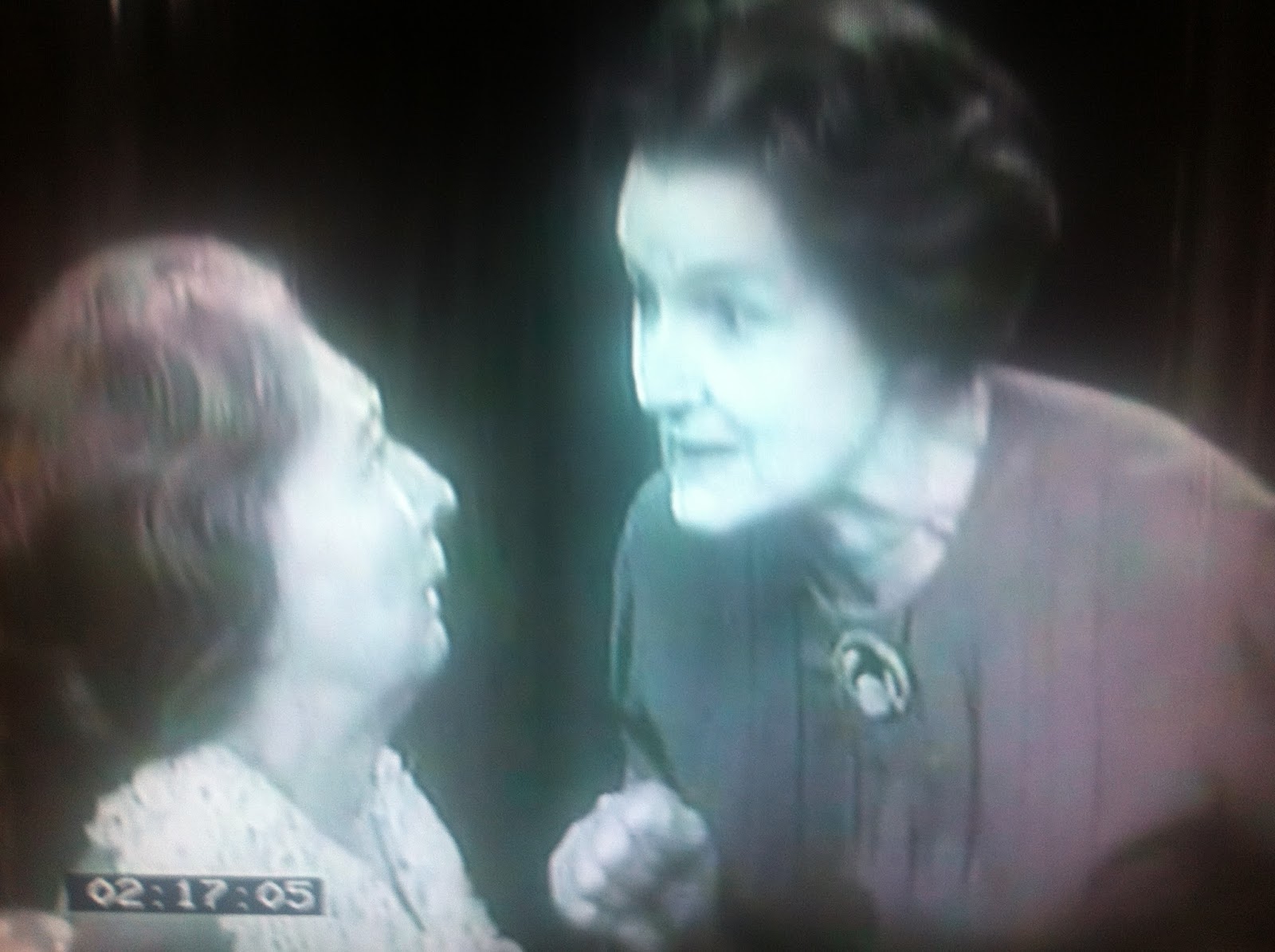
The story ends like a Tale of the Unexpected, with Flora rising from her bed on hearing Harriet out of her room, only to fall down the stairs (it's the second programme featured here in as many days with an unconvincing stuntperson taking a tumble).
Flora, realising she's covered in blood (I know medical dramas today fairly ooze with gore, but I wasn't expecting it of Dr Finlay), calls out to her sister for help. Harriet, aware of her sister's priorities, sets about cleaning it up as Flora breathes her last.
The Fergusons' story has an only slightly happier ending: the baby survives, but Mr Ferguson turns up on Finlay's doorstep, having lost his job and shortly to lose his home. Rather than resenting the doctor's busybody ways, he now wants them extended to pleading with his employer for him. Dr Cameron, horrified by the sisters' tragic fate (Harriet having just been sent off to a mental home),wearily tells his friend, "What you start, you must finish."
Apart from a pointless bit of padding intended to link the episode's two storylines together (Janet gives slovenly Ferguson daughter Aggie a makeover in the hope of getting her a job as maid-cum-spy at Flora's house - predictably it fails), Clean Sweep is brilliantly written (by Jean McConnell from an outline by series creator A J Cronin) and acted, and unexpectedly emotionally affecting. Pleasant surprises like this are exactly what makes writing TV Minus 50 so much fun.
Apologies for the especially poor quality of the images - my laptop wasn't keen on the DVD-R this episode was on, so I had to (unsteadily) take pictures of the images from my TV screen.
Wednesday, 11 September 2013
Wednesday 11 September 1963
Jock Weir and Fancy Smith are on patrol when Jock notices someone prowling around inside a house with a flashlight. Investigating, they find milk bottles lined up outside the door (it must be very inconvenient for the police that so few people have milk delivered these days). They break in and search the house, eluded by a stealthy, shadowy figure. Eventually the figure proves not quite so stealthy when it tumbles down the stairs in an attempt to escape.
That's a stuntperson, of course - when apprehended by Weir and Smith, the mysterious figure turns out to be... Judi Dench!
Jock and Fancy arrive at the station with their charge as PCs Lynch and Graham (James Ellis and Colin Welland) are struggling with a similarly difficult character, the sinister, mocking Kenneth Harvey (Peter Woodthorpe, who has one of the most remarkably expressive faces I've ever seen), who's on a charge of loitering with intent.
As Sergeant Watt struggles successively with Elena and Harvey, Jock and Fancy pay a visit to the girl's disapproving parents (Peter Claughton and Lala Lloyd). They're pure Victorian melodrama, the stern patriarch only inviting the policemen in because "Public spectacle is something I've no wish to encourage". The visit proves a dead end: Mr and Mrs Collins have entirely disowned their daughter for her wayward behaviour and wish to know nothing about her
Accompanying Elena as she appears before the magistrates, Fancy begins to take a shine to her. But he's not the only one: bumping into each other on their way in and out of the dock, Elena and Harvey share a moment.
Elena's put on parole, and there's clearly something on her mind.
Later, Fancy's at the local coffee bar, failing to impress the birds with his offers to provide them with music: "What do you fancy then, the Beatles?"
His attempts at chatting up the cashier are interrupted when Elena comes in sporting a nasty black eye. She's not keen to chat to Fancy about the cause, but it quickly becomes obvious when Ken Harvey appears, and cautions Fancy against talking to his bird. Fancy, who's developing a troubling obsession with the girl, is aghast at learning she and Harvey are a couple. Only a swift intervention from Jock stops the pair coming to blows (by the way, I'm highly intrigued by what a Milk (Special) might entail).
After Fancy's ushered out by his partner, Harvey shows us just what a nasty piece of work he is: "Little girls should be seen and not heard!"
Jock cautions Fancy about his growing obsession with Elena and determination to save her from Harvey's slimy clutches, insisting he's just interested in her because "she's a nice bit of stuff" - which at any time would seem a peculiar way of describing Judi Dench. He thinks Elena and Harvey are both low-lifes who deserve each other. This fails to put Fancy off, though, and on learning that Elena's gone missing from the hostel where she was meant to be staying while on parole he takes the massively unwise step of bunking off duty to visit Elena's parents out of uniform to implore them to take an interest in their child. It's a dead end, of course, and when the rogue officer finally tracks Elena down he gets his face spat in for his trouble.
Elena mocks Fancy's interest in her by contemptuously offering to have sex with him if he'll let her go. The episode ends with him facing the crushing revelation that Elena wasn't just staying in those empty houses: she was helping Harvey rob them, and Elena pleading guilty in the dock. The end credits play out over a still of Fancy and Elena that raises the question of who the episode's title refers to.
Made for Each Other's a powerful episode on its own merits, though to modern viewers the thought of Brian Blessed being sexually obsessed with Judi Dench has a fascination all of its own. What makes it especially compelling, though, are the top-notch performances from Blessed, Woodthorpe, and especially the episode's leading lady. Clap her, she's Dench.
Saturday, 7 September 2013
Saturday 7 September 1963
This week's Cork revisits the plot of an earlier episode, The Case of the Respectable Suicide (a seemingly upstanding citizen is found dead, and in the course of his investigation Cork finds the man was nowhere near as virtuous as he seemed) and features several other elements familiar from previous instalments. The effect is of a sort of greatest hits package, but lest anyone worry it's far too early for the show to start recycling itself, The Case of the Public Paragon throws in enough angles of its own to dispel any fears Cork might be going stale.
Corpse of the week is the late Gerald Manley, an MP who was on the brink of of becoming a minister. On a dark and stormy night his wife (Yvonne Coulard) returns home to find the maid, Jenny (future Father, Dear Father star Natasha Pyne) absolutely terrified. Is it the storm that's frightened her or ... something else? Entering her husband's study, Mrs Manley finds a burly fellow (Ray Austin, not for once cast in order to take part in a fight scene) standing over her prostrate husband with a candlestick.
The assailant escapes and Mrs Manley hastens to alert the household to the tragedy (once again there's a very obvious microphone in shot).
Cork soon arrives on the scene, as does Mischa De la Motte's insufferably pompous Dr Buller, making a welcome return as a foil for the Sergeant. This time he's in a strop over Bob Marriott's indecent practice of sketching the body.
After a soul-sapping encounter with the aggressively boring cabman who drove Manley's attacker from the crime scene, Cork sends Marriott on a tour of the slums of Wapping to look for the mystery man , while he pays a visit to Morley's friend and sponsor in Parliament, Sir Jervase Wallworth (James Mason-alike Jack Gwillim). Sir Jervase is convinced, on the basis of no evidence whatsoever, that Irish malcontents are behind Manley's death: "When England is in peril, look to Ireland!" he cries, a maniacal gleam in his eye.
Cork catches up with Marriott in Wapping just in time to prevent him being beaten to a pulp by a surly householder who doesn't like the look of him. The more experienced detective urges caution in such rough neighbourhoods:
"Don't you know in the Thames division they used to run double police patrols in this district?"
"Why did they stop?"
"Because it meant two policemen getting beaten up instead of one."
The pair call on a melancholy elderly woman, Mrs Barnes (Ann Tirard), who claims ignorance of Manley's killer. Marriott's mind is wandering: he characteristically homes in on a photo of her beautiful daughter. After the police depart we learn that the man Mrs Manley saw is, in fact, the woman's son.
Cork and Marriott return to the Manley home, and just miss Sir Jervase giving Jenny the maid a guinea to say nothing about something that passed between them the previous night...
Sir Jervase is hanging around his dead friend's home to retrieve some papers from Manley's study, which Cork has locked. "I've been seriously inconvenienced!" he huffs to the impassive Sergeant. "Well, murder's a very inconvenient crime," Cork responds wryly, with his usual inspiring lack of respect for his social betters.
Things take an intriguing turn when Bob finds among the papers a copy of the photo he'd admired just the night before. Sir Jervase rather unconvincingly denies all knowledge.
Once the MP's grumpily departed, the truth about Manley begins to come to light as Cork discovers a far more interesting stash of photographs. The normally worldly Bob is horrified: "These are pretty disgusting. I don't mind a bit of honest sex , but these - they're enough to turn your stomach. They're sickening."
"Well, pornography usually is," says Cork, spelling it out for any viewers who haven't quite got it. "And Manley was an enthusiast." "His mind must've been twisted," gasps Bob. Cork's been around long enough to know that Manley's enthusiasm's shared by many of the country's top figures: "There's lots of stuff between those Morocco bindings which isn't exactly literature". Needless to say, we don't get to see the slightest hint of any of these sickening images, or receive any more information as to what precisely they depict. Which rather gets the imagination going. Still, it's hard to imagine other shows of this period, even hard-hitting ones like Z Cars, being so frank (if unreservedly condemnatory) about porn. Once again it seems that Cork's period setting is the perfect vehicle to present the audience with things that would be too uncomfortable in modern dress (especially on ITV of a Saturday night).
Intrigued by Jenny's obvious terror of Sir Jervase, Cork manages to draw from her the story of how he and Manley forced her to pose for pornographic photos. In a moment of extreme cruelty that shakes our faith in him a bit Cork angrily accuses Jenny of lying, only to reassure her that it was just to see her reaction in order to make sure she was telling the truth.
Back in Wapping, Tom Barnes confesses to his mother that he killed Manley, but before they can discuss it in any detail he has to hide when Bob turns up, wanting to know more about the girl in the picture. Breaking down, Mrs Barnes reveals that the girl's body was fished out of the river weeks before. Ann Tirard's heart-wrenching performance as the grieving mother is reminiscent of Patsy Smart's in The Case of the Sleeping Coachman, except here the scene is stolen by a cat who's clearly fascinated by the camera.
Cork realises that the powers that be won't be keen about his investigation into the dark secrets of the country's great and good (I don't know whether this episode was written after the Profumo scandal, or whether the plot's just a felicitous coincidence), and warns the young man to disassociate from him before his career's destroyed too. Bob, of course, is having none of it. Together the pair visit the insalubrious Minnie's Parlour, where another former maid of Manley's (Patricia Denys) has ended up. On learning of Miss Barnes' death her chilling response is "Oh well, her troubles are over. She's lucky."
Confronted with Cork's knowledge of his activities, Sir Gervase tries to convince the detective of the need to keep his weaknesses and those of men like him hush-hush: "Look: Victoria's empire. The greatest since the time of Rome. And why? Because of its merchants, its statesmen, and its bankers. The very people that this will destroy. And all for the sake of a few starveling brats!"
The desperate Sir Gervase finally tries to bribe Cork with promises of promotion: "Cork, please! I'm offering you charity!" The Sergeant's no longer able to conceal his disgust: "You starve the parents, you debauch the children, and you ask me for charity?"
This truly remarkable episode wraps up with the revelation that it wasn't Tom Barnes who killed Manley after all. Mrs Manley didn't alert the household to the death of her husband as promptly as all that: she took the opportunity to suffocate the badly injured man first. She knew all about his exploitation of the stream of young girls in service with them, and finally found the strength to take action about it. Sergeant Cork is, for TV in 1963, a remarkably progressive show, but the spectre of sexism often hangs over it with its frustratingly poorly developed female characters. Mrs Manley's final confession of guilt begins to redress this. The dialogue between she and Cork as the episode closes is a scorching critique of the place of women in the 19th century (and, by extension, the present), electrifyingly brought to life by John Barrie and Yvonne Coulard. I think it's worth quoting in full.
Cork: Had he some hold over you?
Mrs Manley: Some hold? Yes. The restraints of our society, and the place a woman has in it. You ask me why I didn't leave him, didn't divorce him. How? Where would I begin?
Cork: Well, you could've collected evidence, Ma'am...
Mrs Manley: Oh no! My education fitted me for gracious tea parties and elegant conversation, not sordid investigations. And if I had obtained the evidence, what would a divorce have brought me? When I married Gerald Manley everything I owned became his property. Where would I have gone? How would I have lived? What rights has a woman under the law? And then there would have been the scandal, the cheap music hall jokes. No, I couldn't have borne it. Then, too, I thought I might have been able to curb his excesses. No... I can't say I regret having killed him. Can you?
Cork: That's one of the paradoxes of our profession, Madam. We can sometimes sympathise, but we can never approve.
...And now to the slightly more upbeat world of popular music. Billy J Kramer and the Dakotas are still at number 1 with "Bad to Me", whilst that song's writer, John Lennon, and his bandmates, have zoomed up to number three with their latest recording in only its second week in the chart.
Friday, 6 September 2013
Friday 6 September 1963
Kate Starling's off to the outer reaches of Luton to look after her poorly gran. She's far from convinced that husband George will be able to cope in her absence, and before she departs gives detailed instructions on how to heat up the contents of tins and packets. George is unimpressed: "I'm not an idiot," he bristles. "Yes you are darling, that's why I love you" is Kate's unanswerably condescending reply.
Prunella Scales and Richard Briers' sheepish performances brilliantly capture the awkward silence when you've said your goodbyes, but it's not time for the other person to leave yet after all.
It's the first time they've been apart since they married. The series' resident Mephistophelean tempter, George's workmate Miles, seizes the opportunity to try and set George up with another colleague, Cherry (Lyn Pinkney), whose hobby is married men. George agrees to accompany Miles on a boys' night out, but intends to do nothing more transgressive than bring fish and chips home (Kate won't allow them in the house, as she erroneously believes she can cook just as well as the local chippy). "The slave has been given his freedom and the acme of his desire is sixpennyworth of fried potatoes," Miles mocks.
George's visit to that establishment is made particularly stressful by being stuck behind a soul-destroyingly morose and indecisive old woman (Nora Gordon), who ends up taking the last of the chips.
The interior ofthechip shop is fascinating, with the proprietor serving at the counter and a prim cashier sat at a desk safely removed from the frying to take the customers' money.
Returning home to consume his chipless fish, George finds that while Kate may be physically absent, her admonitions to him live on in a seeming endless series of notes placed around the house, all stating the bleedin' obvious.
To make things worse, George's plans for the evening are somewhat scuppered when neighbour Nora informs him that Kate intends to call him at 8. Dashing to the pub for a quick one, he finds that his friends have all brought their wives out (future Hammer horror starlet Suzan Farmer among them).
George goes back home to take Kate's call, telling his friends to meet him there in a short while. An hour later, he's still awaiting the call, and his supply of sweet sherry has nearly been cleaned out by his thirsty guests. Once they've abandoned him the phone rings - but it's the persistent Cherry, intent on paying him a visit. Midway through the call Kate returns, Granny now much better and not needing her care.
All's well for a few minutes, then Cherry arrives on the doorstep...
The Parting is another fairly disappointing episode, the characters that seemed to have so much potential at the start of the series degenerating further into one-dimensional stereotypes: George a gormless man-child, Kate a hysterical nag. The episode's ending's especially frustrating, with Kate running to the bedroom in tears and slamming the door after answering the front door to Cherry (it's the first episode that doesn't end with the Starlings making up). The show's not terrible by any means, but The Marriage Lines is shaping up to be a bog-standard sitcom when it initially promised more. Still, there are another six episodes of this series yet to go, plenty of time for it to get back on track (I hope).
Subscribe to:
Posts (Atom)


