Showing posts with label Steptoe and Son. Show all posts

Monday, 21 April 2014

Tuesday 4 February 1964


I'll start off by saying that this is possibly my favourite episode of Steptoe and Son, thanks to its brilliant skewering of cinema culture in Britain at the time it was made.  If I ran a film studies course, this would be compulsory viewing.

The Steptoes are getting ready for an outing to the pictures.  Harold fetches his socks from the oven, where they've been drying, experiencing near-orgasmic pleasure as he pulls them on: "Sheer ecstasy... the magic of hot socks!"


We're also treated to an insight into Albert's wardrobe that black and white television wouldn't normally allow us, as his son scolds him for his inability to co-ordinate: "We do not wear our green and white spotted scarf with our blue tie with the jagged stripes on, do we?" Harold's appalled by Albert's view that it doesn't matter what he wears as he'll be in the dark anyway: "You might as well say there's no point washing any higher than the neck or any lower than the wrists.  The grimly inevitable response: "I haven't."


Harold's even more disgusted by the revelation that Albert's still wearing his pyjamas beneath his suit.  And a pair of thermal longjohns beneath those.  It's all justified by Steptoe Sr with the picturesque phrase "I'm colder than a penguin's chuff." (Looking at Harold's tie we may note that his clashing horizontal and vertical stripes aren't much better than what he criticised his father for).


The Steptoes' attempt to decide what to go and see gives us a decent snapshot of what cinemas had to offer in early 1964.  There's The Monster from the Black Bog, but Albert went to see that at a matinee during the week.  His description of it is such a vivid portrait of the reception of the endless cycle of British horror films being churned out at the time by Hammer and its imitators - and their often barely coherent plots- as well as of the contemporary experience of cinemagoing, that I'll quote it in full.

Albert: Cor, you should've heard those old birds screaming! Good film, though.  There was this great big thing about 200 foot high.  It rose out of the bog, all dripping with slime.  Radioactive, it was.  And it went through London, knocks the buildings down, and then it picks up this bird and bites her head off! Just like eating a jelly baby it was.  Talk about laugh!

Harold (drawn in, despite himself): Why was it radioactive?

Albert: Well, you see they'd been dumping atomic waste from the power station in the bog, and it brought him back to life.

Harold: How did it end?

Albert: I dunno.  Some silly old cow sitting next to me complained to the manager, and I got thrown out.

Harold: Thrown out?!

Albert: I didn't do anything! I dropped me glasses, that's all.  Skinny old legs she had, anyhow.  I'd sooner've had a go at the monster.


Jason and the Argonauts is on at the Majestic, but Albert's seen that too (Harold's not keen on the idea of him sneaking out to the pictures when he's meant to be working at the yard).  Albert wants to go and see Nudes of 1964 at the Argosy, but Harold swiftly vetoes it: "If you get thrown out of The Monster from the Black Bog, Lord knows what would happen if you got in there."

Harold explains that "For me the cinema is an art form, not a tawdry peepshow".  He decides they'll go and see Fellini's 8 1/2 at the Playhouse.  Albert finds it confusing before he's even got there: "Eight and a half? Eight and a half what?... Why eight and a half? Why not seven and three quarters?... Maybe it's his hat size."

The film comes highly recommended by Harold's favourite film critic, the Observer's Penelope Gilliatt ("I find her tastes and mine coincides all the time"), and besides, his a big fan of Federico Fellini ("Didn't he used to sing with Charlie Chester?" asks Albert). Albert's reluctant: he hates subtitles: "I go to the films to see a picture, not to read.  I can read here," but despite his initial reluctance ("I don't want to wear me glasses if I'm not seeing any crumpet") is prevailed upon to pick out a pair of specs from the huge, tangled mass he keeps in a drawer.


We head to the cinema - the poster for 8 1/2 juxtaposed with that of Nudes of 1964 next door (the imagery they use is pretty similar - intellectuals want to see crumpet too, it seems to imply, but they need to justify it by having it inserted into a meandering plot).


Albert feels no such need to justify his interest in looking at women's bodies.   "We are going to see Fellini's 8 1/2, Harold urges as his father stops for an ogle.  "I'd rather see her 48 1/2!" chortles the dirty old man.


As they queue, Albert annoys the other patrons by moaning about pretentious dream sequences in the arty films Harold's dragged him to in the past: "Oh no, not another one of them! Not another like Last Year at Marienbad.  That was another one of your dreams.  Even you didn't know what that was about... If they wanna experiment let them do it with their own money, not my 4/6."  Cheesed off with the rubbish he's been made to see, Albert waxes lyrical about the golden age of Hollywood, disgruntling the queue by launching into an impromptu Top Hat routine.  Still, he finds a kindred spirit in ticket clerk Damaris Hayman, who keenly shares his reminiscences of Lost Horizon and The Good Earth.


Albert continues to provide his son with maximum embarrassment when they get inside, loudly demanding to go to the loo, falling through his seat, loudly cleaning his glasses and necessitating several changes of where they sit


While Albert disturbs everyone in the theatre by going to get a drink (it turns out that even in the 60s cinemas were charging ludicrous prices for refreshments), Harold tries to get to know a young lady sat next to him - much to her boyfriend's dismay.


Albert's slurping and loud interruptions during the film provoke the ire of the man sitting behind the Steptoes, eventually leading to an auditorium-wide ruckus that sees the manager ejecting Harold for harrassing his female neighbour.  Albert is not kicked out, but decides to leave voluntarily.


Once they've left, Albert can't get in to see Nudes of 1964 fast enough.  Appalled at the behaviour of his "subhuman" father, Harold waits a few seconds, turns up his collar and follows the old man in - making sure he gets a seat on the other side of the cinema.


An acknowledgement in the end credits reveals that the actual soundtrack to 8 1/2 was used in the episode.  What's not revealed is the significance of the episode's title: is Sunday for Seven Days meant to echo the oblique titles of arthouse movies? Or am I missing something obvious? Write in if you've got any ideas.

Tonight's episode of The Plane Makers is one of the show's more business-focused instalments, which I tend to dread.  But thanks to a breezy script from Tony Williamson and some interesting character development, it's actually one of the most enjoyable episodes yet.


There's a flu bug flying around the Scott Furlong works, and Arthur Sugden's secretary Margie's been hit especially badly.  Arthur doesn't have time to notice, though - he's too busy running the business while John  Wilder's in Italy negotiating the sale of four Sovereign jets.


Things are due to get increasingly difficult for Arthur: the episode's title refers to the buyers' insistence that the Sovereign used for the demonstration flight be fitted with a new Mark 7 engine: which isn't due to be in production for another year or so .  Arthur's placed under enormous pressure to accomplish the seemingly impossible, within a week.  The first hurdle he faces is the workers, who need to be informed they'll have to rip out an engine they've just put in and replace it.  He leaves that task to hapless foreman Ted Castle (Charles Lamb).


Arthur himself requests that the less-than-impressed engineer, Dave Richards (Douglas Hayes) draft a completely new design within a couple of hours.


Meanwhile, Margie's getting worse: Wilder's secretary Kay Lingard takes charge, bustling her off home.  Arthur barely notices she's gone, he's too busy trying to negotiate with engine manufacturers Crane Wescott.  Their director Mr Lewis (Lloyd Lamble) insists it's no can do, as he's got his hands full - apparently with his secretary.


Arthur decides he'll have to pay a trip to Manchester himself to see the company's notoriously difficult boss, Sam Wescott.  Meanwhile, Kay's stepped into the breach to take Margie's place for a few days.  As she tells a distinctly nervous Arthur, "I've just told Mr Wilder on the phone that I'm keeping an eye on you.  He's only too delighted."


The workers are threatening to revolt over the mandatory overtime Arthur's imposed in order to get the new engine fitted in time, but he manages to defuse the situation by promising shop steward Jack Wilks (Douglas Blackwell) a new shift system will be implemented if the job goes according to plan.


As he reveals to Don Henderson (acting as Wilder's mouthpiece), Arthur is worried his boss has deliberately set him up as a scapegoat should the Italian deal fall through.  Don dismisses the notion, but suggests he should use the military version of the Sovereign - for which Crane Wescott expect to provide the engines as a weapon to get Sam Wescott to do what he wants.  Arthur, who knows full well that there isn't going to be a military version is horrified by the idea of being so deceptive, and even more uncomfortable when Don points out that it's exactly what Wilder would do.

One of the best things about the episode is its expansion of the character of Kay Lingard, who up to know has had little to do other than be super-efficient beneath an elaborate hairdo.  During her time working with Arthur the pair build up an unlikely but sweet friendship.  She accompanies him to Manchester, and on the way there is strangely dazzled by his tales of growing up in Ossett, near Wakefield - she's never been north of Birmingham: "I always get Yorkshire and Lancashire mixed up."  "You'd better not let them hear you say that at Old Trafford!"


George A Cooper plays Sam Wescott, who proves impervious to all Arthur's attempts at speeding up production on the Mark 7.  Arthur's fear that he's been set up as part of a devious Wilder plot grows when Sam reveals that he spoke to Wilder just a week before and there was no mention of the matter at all.


Arthur invites Wescott and Lewis to dinner at his hotel, in the hope that a deal could be worked out in more convivial surroundings.  Can he swing them with his idea of cutting out the lengthy testing process on the engine by doing it in the Sovereign itself (I know this all sounds pretty dull, but the whole thing moves along at a fair old clip).  Meanwhile, a flabbergasted Don Henderson receives a phone call from Wilder announcing, without explanation, that the new engines aren't required after all.  Henderson decides to postpone telling Arthur.


It's the audience's knowledge that Arthur doesn't need to get hold of the engine immediately after all that gives the remaining part of the episode its power.  As Sam and Arthur continue to debate the issue of the engine, Kay and Lewis go for a walk.  They both head to Kay's room, where she doesn't put up much resistance to Lewis' attempts to snog her.


Arthur, seeing them come down, asks Kay what's happened.  She's entirely blasé about Lewis's advances, but Arthur's absolutely horrified.  Confronting Lewis about it, and threatening to tell Sam, all he gets is the man's scorn for being so naive about the way business is done.  Realising what he's dealing with, Arthur decides it's time the gloves were off, and informs Wescott that if he doesn't get the engine straight away, the contract for the military Sovereign's engines will be awarded to someone else.  It works, of course.


In the train on the way back, Arthur's in turmoil about the Wilderesque deception he's pulled, and also about Kay being subjected to Lewis's filthy pawing.  Turns out Arthur's even more naive than he thought: Kay calmly explains that she's entirely used to that sort of thing, just seeing it as a necessary part of the job.  This final scene seems chilling now not so much because that sort of thing's so much more widely condemned these days, but because of the likelihood that, nonetheless, it's still going on.


Thursday, 3 April 2014

Tuesday 28 January 1964


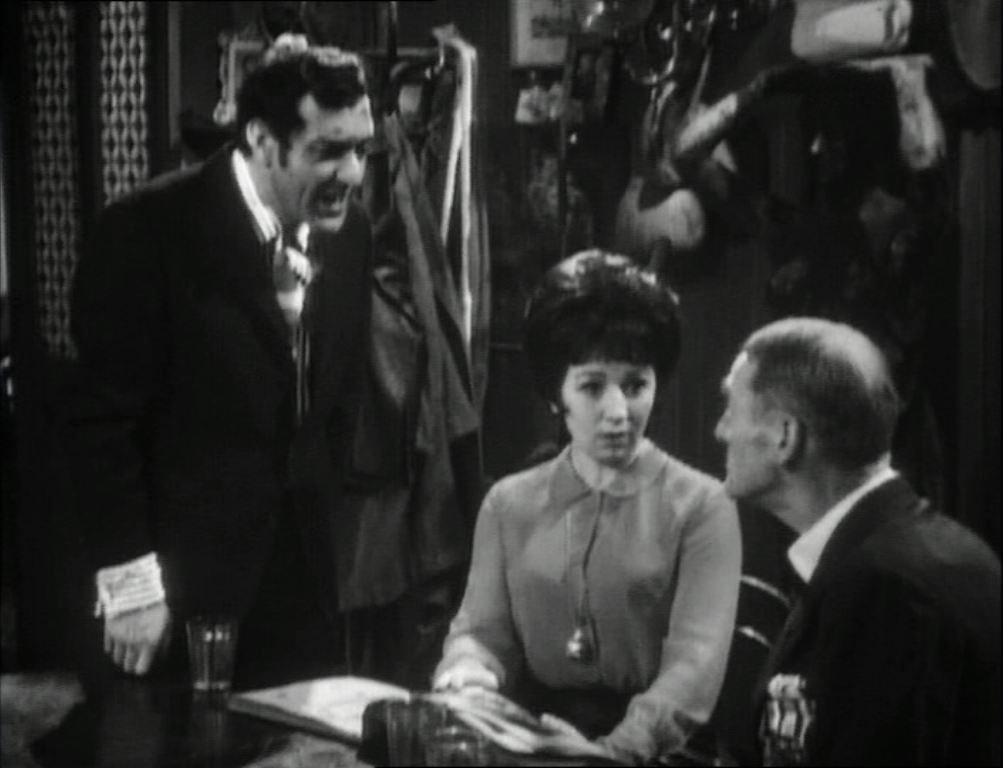
By means unknown, Harold Steptoe has gained access to an exclusive block of flats in order to pester the residents about selling their junk.  We learn just how exclusive the place is when Harold has a door opened to him by a forbidding butler (Frank Thornton), who tells him to hop it in no uncertain terms.
"You capitalist lackey!" snarls the rag and bone man, "You wait till the election!"


Harold gets a warmer reception from Gwendolyn Watts as French au pair Monique (her English isn't very good: "Me scrubber!" she announces by way of explaining what she does around the place).


Despite the language barrier Harold's instantly smitten, and works up the nerve to ask her out.  "Me not always look like this," he tells her, in classic "loudly addressing a foreigner" style, "Me dead sharp when dressed up.


At the Steptoe residence, Albert's cutting a rather bizarre figure dressed up in some African tribal gear he's bought.  This vignette, and the "African" arrangement of "Old Ned" that accompanies it may well have been influenced by the opening of Zulu just a few weeks previously.


Arriving home to see his father in this unusual garb, Harold finds the spectacle risible to say the least:  "You must admit it's a bit kinky, isn't it? I dunno, there's a definite touch of The Avengers about you sometimes." (I think this might be the first time one of the shows I write about here has referenced another).


It's strangely poignant when a sheepish Albert tells his son he was "Just having a little try-on, a little pretend."

This scene seems to take place some weeks after the first one, with Albert questioning Harold about why he's been out every night, and finally deducing it's all because of a bird.  The dialogue here's almost identical to that from the earlier episode "The Bird", and the hearty laughter from the audience may be because some of them had become familiar with it through multiple listens to the massively popular Steptoe and Son LP, which included an audio recording of that episode.

Having failed to get Albert out of the way for the evening, Harold has to endure the old man's ridicule when he puts on a Teach Yourself French record.  Albert thinks there's no point to learning languages: "What are you trying to do, get us into the Common Market? Gonna take Mr Heath's place, are you? Or are you going totting around Paris, you great fairy?"


Harold explains that his new girlfriend is French ("I see, you can't get hold of an English bird, so you have to get hold of a wog!").  According to Harold, Monique is from a wealthy landowning family, and he has dreams of running their vineyards for them.  Albert's a tad sceptical, and even more so of Harold's claims to be in love with Monique.


Harold decides that as he's serious about Monique, he'll have to take the plunge and introduce her to his father.  He begs Albert to be good when she comes round: "I promise to be the soul of discretion," Albert says, shiftily.

Next evening, Harold's amazed to see how beautifully Albert's done up the parlour, with Union Jack and Tricolore on display.


Monique and Albert get off to a dodgy start ("Ah! So this is old Misery Guts!" she exclaims upon meeting him), but Harold's soon horrorstruck by the revelation that Albert is fluent in French, and so can converse with Monique far better than he can (it's a brilliant pay-off to Harold's earlier taunts to Albert that he was stationed in various countries in World War 1 but didn't pick up any of the lingo).


Much to Albert's enjoyment, Harold's utterly humiliated, and rushes to his French dictionary for help.  "Et que voulez-vous boire, mon petit?" Steptoe Sr asks his son at one point.  "I beg your pardon?" asks a flustered Harold.  "What do you want to drink, you great pillock!"


Harold takes his father aside for a moment to take him to task for concealing his facility with the French language (and for stealing his bird).  Albert tells him he learned the language when he was billeted in a French village: "I've been out with French birds too, you know.  That's where I learned it.  Much better than records!"

But there's a shock in store for the Steptoes: in his conversation with Monique Albert learns she's from the same village he stayed in.  Getting out his photos of the period, he's alarmed when Monique recognises a woman in one of the pictures as her grandmother.


A stunned Albert realises that this means he's Monique's grandad: he and her grandmother had been in love and planned to marry but were separated by the war: later he learned she'd had a little girl.  Obviously Albert's just assuming she didn't have any children with anyone else, but Monique seems convinced by the story, and is overjoyed at discovering her long-lost Grandpére.  On learning the news Harold's slightly less enthusiastic: "I find the whole sordid affair entirely repugnant!"


Invited to join in the celebration, Harold can only sit and let the horror of having planned a future married life with his own niece wash over him.


"She looks like me, don't she?" Albert asks him.  "She's got my nose, and my eyes."  "Yes," responds Harold.  "And when she goes home you're going to get my bleeding fist!"


It looks like Scott Furlong's ruthless managing director John Wilder might finally have met his match, in the unlikely form of a 69-year old spinster.  Miss Geraldine Pettifur (Marie Lohr) owns two large properties that Scott Furlong plans to annexe in order to expand the operations.  But despite her hatred of the noise made by the planes constantly flying over her house (which she constantly writes to make the company aware of), Miss Geraldine refuses to sell.  A relic of the pre-World War 1 era who refuses to live in the present, she was born in her house and is determined to die in it.  The other owners of land surrounding the Scott Furlong factory have been easy enough to buy out, but as Wilder notes, there's little point just offering Miss Geraldine money: "She's enough to buy us out!"  If its plans are to stay on course, Scott Furlong needs the Pettifur property in just over a week.

A long stream of Scott Furlong executives have gone to plead their case to the old lady, only to return with ears boxed and tail between their legs.  Wilder's decided the man for the job is Nigel Carr (Jeremy Burnham), the company's biggest smooth talker.  He arrives at the Pettifur residence at 12 pm, which unfortunately is when Miss Geraldine has her lunch every day (in keeping with tradition it's always the same thing: the rather mind-boggling dish of eggs and brandy).  Miss Geraldine's long-suffering companion Harriet (Ruth Kettlewell) announces the gentleman's arrival.  The old lady's response tells you everything you need to know about her character: "At luncheon time? A gentleman? You're using the language loosely again, Harriet!"


Despite his reputation for getting any female eating out of his hand in two seconds flat, Nigel Carr fails miserably with the formidable Miss Pettifur: "Oh, I do hope they haven't sent a nincompoop just to dispense flattery!" she frets.  Carr's patronising treatment of Geraldine as a fluffy old dear turns out to be a huge misjudgement.  She lets him twinkle away, before apprising him of exactly what the situation is regarding her land: "I want it, and you want it.  Unfortunately for you, I have it."


A sheepish Carr reports back to Wilder, embarrassingly worse for wear after an accident at the Pettifur residence.  Wilder is incandescent at his underlings' inability to talk Miss Geraldine round.


"Am I surrounded by idiots, Miss Lingard?" he asks his secretary, who's sporting yet another new hairstyle.  "Yes, Sir," she calmly responds.


Deciding it's the only way he'll achieve his aim, Wilder heads off to see Miss Geraldine himself.  Perfectly friendly toward her sworn enemies, the old lady plays him at croquet (the genteel croquet lawn with massive jet in the background is the episode's most potent image).  Wilder proves useless at the game, though Miss Geraldine, having sized him up in a moment, tells him "I'm sure there are many games that you invariably win at."


A strange kind of flirtation develops between the two - Wilder (who, by way of setting the two up as opposites, tells her his job requires him to live in the future) takes the tack of being deadly earnest with Miss Geraldine about his motives: he describes the way her house will be demolished, with "all this beauty" eventually replaced by "an efficient box".  "I hate your progress," she tells him plainly.  "If you moved from here, with our help," Wilder responds, "You'd be rid of that noise forever."  He's caught totally off guard by her response: "Then what would I have to complain about?"


Geraldine, dwelling, as ever, on the past, tells Wilder he reminds her of her old sweetheart: his death in the First World War led to her current Havisham-esque existence: "It wasn't only Arthur who died that weekend, it was everything."  Geraldine tells Wilder of the half-life she's lived for the past 50 years, and that it's only her running conflict with Scott Furlong that's given her something to live for once more.  He's utterly gobsmacked when she reveals the result of his own intervention:

Geraldine: I think I might very well have faltered.
Wilder: You mean, sold out? To us?
Geraldine: Yes, if I hadn't met you personally.
Wilder: If you hadn't met me?
Geraldine: Yes.  It's only when one meets the best of the opposition that the game becomes really fun, don't you agree?


The flirtation analogy becomes explicit when Miss Geraldine arrives at Scott Furlong for her first ever flight, in a Sovereign jet.  Wilder urges Auntie Forbes to treat the old lady as if it was a love affair - utterly baffling to Auntie, who's clearly never had one.


The old lady's overwhelmed by her first trip in a plane, but eventually enjoys the experience immensely.  "But are we any better off for it, Mr Wilder?" she asks.  Wilder, in perhaps the show's best insight so far into what makes the character tick, talks of the sense of pride and fulfilment he gets from running a successful company.  She sums it up as "power", a word Wilder rejects as too loaded (though it will prove an important one in the character's trajectory on TV).


Miss Geraldine gets a grand tour of the Scott Furlong works.  Her hibernation from progress for the past 50 years is precisely what makes her so fascinated by every new piece of technology she sees as she travels this palace of modern marvels.


One of the episode's highlights sees Miss Geraldine embarrassing Wilder by enthusiastically greeting a group of workmen whose names he proves unable to tell her.  Wonderfully, the elderly aristocrat happily joins them in a cup of tea, deciding "I must send Harriet here to take lessons about how to make tea, good and strong."


After he sends Miss Geraldine back home, Wilder instructs his men to press on with their development plans, secure in the knowledge that he's won.  On his next visit to Miss Geraldine's he lessens the charm a bit to spell it out to her.  If she doesn't sell up she'll have a runway at the bottom of her garden and an engineering works at the end of her orchard.  Besides, the factory's defence work means he could probably get a compulsory purchase order anyway.  "You're no gentleman, Mr Wilder," Miss Geraldine scolds him.  "You take all the fun out of it."  She graciously accepts defeat, but not before she's secured double Scott Furlong's original offer.


The minute Wilder's gone Miss Geraldine gets on the phone to her broker, and insists that her entire share fund be ploughed into Scott Furlong...


Miss Geraldine is a terrific Plane Makers, with Patrick Wymark getting a rare chance to make John Wilder a likeable character.  And it's hard to imagine anyone being more perfect than Marie Lohr in the episode's title role.  A stage star since the Edwardian era, Lohr's best remembered today as the society matron who dies protecting her village from Nazis in the Ealing classic Went the Day Well? Her role in The Plane Makers is almost a reprisal of that part, but with the forces of progress the new invaders, and ones that prove far more implacable.