Saturday, 5 April 2014

Thursday 30 January 1964

Hello all.  I hope you're having a celebratory Babycham (I know I am - just the one before moving on to the Cherry B), as it's the 200th post at TV Minus 50.  Yes, I know, I'm surprised I haven't packed it in yet too!


This week, a character we've never seen before (actually one of the scientists from Jupiter, with a beard stuck on), whose job is to look at the sun all day (must go for the eyes a bit, I would've thought) notices an explosion taking place.


The upshot of the explosion is an uncomfortable rise in temperature on Earth and, especially, on Venus, where the president is contacted by a certain Dr Duncan, head of a research lab on Ganymede.  Duncan's a very odd-looking character: from the front he looks like a pale-eyed Desmond Tutu; in profile he just looks utterly bizarre.  It's a shame that the first Space Patrol character to have fairly dark skin should turn out to be a total rotter: Duncan and his fellow Ganymede colonists are unhappy with the conditions on the moon, so the scientist sent a freighter of barillium (whatever that might be) into the sun in order to heat things up on Earth and Venus and blackmail those planets into making Ganymede a nicer place to live.  As the Venusian president sums up: "What a disaster! Earth and Venus at the mercy of a mad scientist!"


On Earth, Colonel Raeburn approaches Professor Haggerty about the crisis, asking him the rather vague question "Do you know a scientist called Duncan?" Fortunately Haggerty knows exactly who he's talking about: Duncan's a former employee of the professor who was sacked after he tried to steal one of Haggerty's inventions.  As such, Haggerty is far from his biggest fan.  Raeburn reveals the new information that Duncan wishes to be "dictator of the galaxy", and has hi-jacked a convoy of barillium freighters, meaning he can now cause another 40 solar explosions.  Something must be done.

Raeburn wants to send troops to apprehend Duncan, but General Smith thinks it'd be a better idea just to blow the whole Ganymede colony up.  Raeburn's worries about killing innocent colonists are all quickly assuaged by the general's insistence that they're probably all just as bad as Duncan (I imagine this is pretty much what happened with the war in Iraq).

 
But Raeburn suggests they try one more thing: sending Larry Dart and his Galasphere crew out to Ganymede for peace talks with Duncan.  The seemingly sensible objection that it might be better to send actual diplomats for that kind of job is countered with Raeburn's secret plan to have the astronauts sabotage the freighters while they're at it.  On arrival, Larry and Husky go for a chat with Duncan, while Slim sneaks off (the usual rule that one person needs to stay on the ship seems to have been forgotten this week) to neutralise the barillium threat and trip over guards.


Slim sets the robot control on the freighters to send them back to Earth, leading to his imprisonment alongside his shipmates.


But Professor Haggerty has an idea: he's invented a device which will make the freighters explode before they reach the sun should Duncan send them in that direction.  Once the devices are fitted the freighters are sent back to Ganymede.  After Raeburn refuses to meet any of Duncan's demands the villainous scientist aims the whole lot at the sun, and the colonel and Professor Haggerty watch contentedly as they all blow up long before reaching it.


Troops are sent out to Ganymede to arrest Duncan for his crimes, his attempts to escape the planet foiled by his own henchman, who's less than impressed with the way things have worked out.


Explosion in the Sun is the last episode in the present run of Space Patrol, but don't worry, it'll be back in a few weeks.

Now for tonight's Saint, an episode packed with incidental pleasures.  As Simon drives around London being patronising about female drivers ("Bless 'em!") we get a good look at a rather splendid Guinness ad.


An interior shot of Simon's car reveals the alarming fact that the street behind him is entirely still: there's even a man who appears frozen in the act of walking...


Strangely, the apparent halting of the world behind Simon is not at all commented upon - instead we plunge straight on with Simon nearly colliding with a car being driven by surly chauffeur Julian Glover (this was before Glover's nose job, and his then-bulbous conk gives him a bit more of a thuggish look than he'd possess in later years).  The chauffeur, Hilloram, is employed by Countess Morova (Dawn Addams, London's most famous society hostess (Simon surreptitiously nicks one of her gloves from the back seat).  Although they've never met, she and Simon recognise each other immediately thanks to their mutual fame:


That evening the countess gives a party for the crustiest of London's upper crust, and afterwards we learn that she, Hilloram and butler Sanders (Ronald Ibbs) are all crooks: while the countess entertains the nobs, Hilloram pops out and nabs their jewels.  On this particular occasion he's brought back some spectacular diamonds but had to knock out a troublesome butler - much to the countess's disgust: she hates violence and remembers all too well the occasion when Hilloram sent a night porter to an untimely end.


While they're examining their loot, Simon turns up with the glove (which he insists the countess dropped).  She invites him and before you know it they're off out dancing the night away.  Simon confesses that both the glove and the car accident were intentional, and reels off a series of robberies he knows she was involved in. She attempts to justify her life of crime by explaining that her late husband left her penniless, but he claims that all he's interested in is joining her gang.


The countess (Audrey to her intimates) is instantly smitten with Simon, but gives him a test to prove himself.  When she accompanies an aristocratic couple to the theatre, he's dispatched to go and empty their safe.  From the brief glimpse we see of it we can deduce that the play they've gone to see is a production of A Midsummer Night's Dream that was staged at the Old Vic in 1957, with Coral Browne as Titania and a concealed Frankie Howerd (whose instantly recognisable voice was not one I ever expected to hear in The Saint) as Bottom.


The robbery's a success (far more of a gentleman than Hilloram, Simon just locks the butler in a cupboard), but on his return home Simon finds Inspector Teal waiting for him, positively glowing at the opportunity to arrest his old adversary.  The discovery that the call about the burglary from a strangely well-informed neighbour was from Simon himself dims him a bit.  Simon explains that he's inveigled his way into Audrey's gang to bring them to justice: not because of any interest in reuniting toffs with their treasures but because he knew the porter Hilloram killed, and wants justice on behalf of his grieving wife and children.  In exchange for the opportunity to carry on with his plan, Simon tells Teal that Sanders will be leaving for Amsterdam with the jewels the next day.  Here, for anyone interested in such things, is some vintage airport signage, as well as a rather splendid Welcome to Britain poster seen behind the inspector as he sends his men off after the dodgy butler.


Hilloram sees the men going after Sanders, and realises they're the police.  He voices his concerns to a dismissive Audrey, then makes an ill-advised attempt at ravishing her.  She's now hopelessly in love with Simon, and Hilloram's consumed with jealousy.


However, they all need to work together (along with a shifty Frenchman named Jacques, played by John G Heller) on Audrey's latest scheme: a yacht trip with three super-wealthy couples who will, during the course of the voyage, be relieved of their most valuable possessions (she's made up a story about a party invitation from Princess Grace of Monaco to ensure they bring their best jewels).


Simon goes ashore for a bit to meet up with a friend, Dickie Tremaine (David Sumner) - who he catches in the middle of chatting up a rather unresponsive French girl.  Simon engages Dickie's help in catching the gang.


Here's a close-up of David Sumner (not to be confused with the lead character in Straw Dogs), for no reason other than that he's the most handsome actor we've seen round these parts in a good while.


Hilloram, trailing Simon, spies on his conversation with Dickie: "Who's he?" he bluntly asks Simon when the Saint spots him.  " A friend."  "Oh?" "Yes, some people do have them."


It's not easy to have any sympathy for the three couples Audrey plans to rob, as they're all ghastly.  Sir Edras and Lady Levy (Gerald Young and Edith Saville) won't shut up about their tedious family; Lord Braden (Michael Gover - strangely uncredited, as is Clare Kelly as his wife) is a a right-wing bore, while Lady Braden's a miserable alcoholic (not surprising really); George Ulrig (Stuart Saunders) is a hopeless hypochondriac, while his much younger wife May (Anne Sharp) never does anything but gripe.


The plan to rob this rotten lot involves a drug which will be put in their coffee after dinner one night aboard ship, rendering them helpless, with Audrey explaining to them after they awaken that they were all the victims of pirates, while Hilloram heads to Italy with their ill-gotten gains.


Hilloram is overjoyed to learn that his suspicions of Simon were right: and that Sanders has been arrested in Amsterdam.  Audrey, on the other hand is devastated, and decides to move the jewel theft forward so any capture Simon's got planned will be thwarted.


The following night, the guests all collapse after their coffee, with Simon having been slipped the drug as well.  Unfortunately Audrey's also had it, Hilloram having decided to get revenge for her throwing him over.  But, as always, the Saint is one step ahead, only pretending to be drugged, and having signalled to Dickie to come aboard and help early.  Together they make short work of Jacques and Hilloram, with the latter ending up plunging overboard to a watery grave.


I should like to point out that the way Simon and Dickie then admire the beauty of the unconscious Audrey is downright creepy.


Simon sees that the guests get their jewels back (though all have to make a hefty charity donation), and doesn't let on that Audrey was behind the theft, instead relieving her of all her own jewels except for those which will raise her enough money to start a new life in South America.

It's an especially fun episode of The Saint, though really I would have like something with more of a celebratory feel for my 200th post.  Those schedulers in 1964 were damned inconsiderate, I say.

Thursday, 3 April 2014

Tuesday 28 January 1964


By means unknown, Harold Steptoe has gained access to an exclusive block of flats in order to pester the residents about selling their junk.  We learn just how exclusive the place is when Harold has a door opened to him by a forbidding butler (Frank Thornton), who tells him to hop it in no uncertain terms.
"You capitalist lackey!" snarls the rag and bone man, "You wait till the election!"


Harold gets a warmer reception from Gwendolyn Watts as French au pair Monique (her English isn't very good: "Me scrubber!" she announces by way of explaining what she does around the place).


Despite the language barrier Harold's instantly smitten, and works up the nerve to ask her out.  "Me not always look like this," he tells her, in classic "loudly addressing a foreigner" style, "Me dead sharp when dressed up.


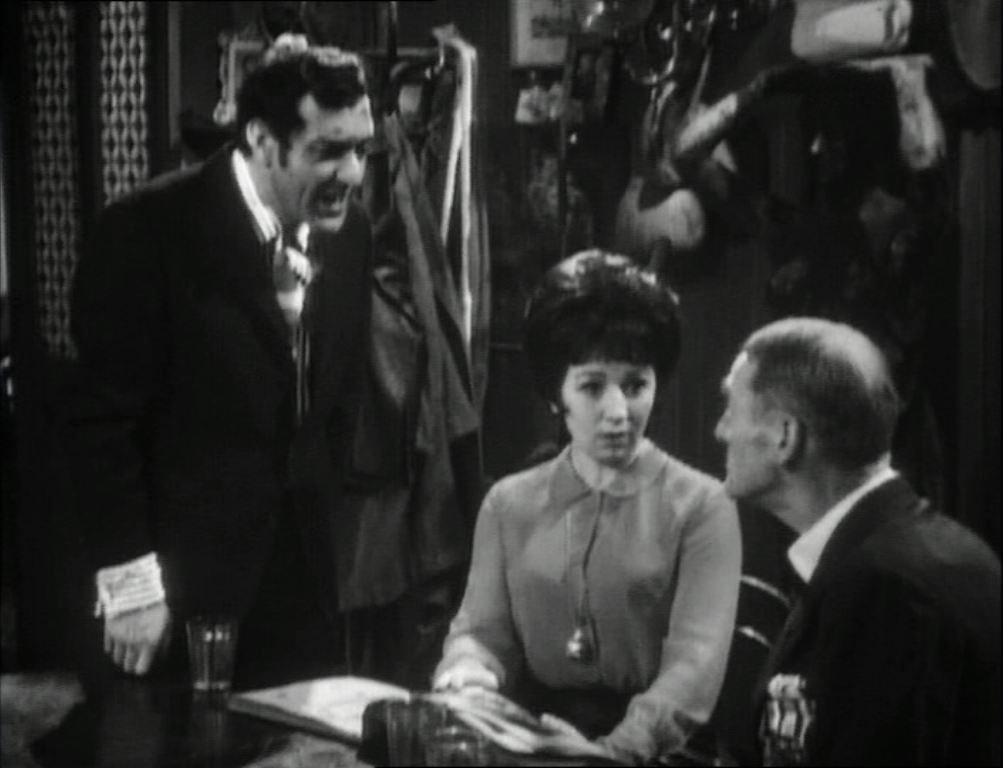
At the Steptoe residence, Albert's cutting a rather bizarre figure dressed up in some African tribal gear he's bought.  This vignette, and the "African" arrangement of "Old Ned" that accompanies it may well have been influenced by the opening of Zulu just a few weeks previously.


Arriving home to see his father in this unusual garb, Harold finds the spectacle risible to say the least:  "You must admit it's a bit kinky, isn't it? I dunno, there's a definite touch of The Avengers about you sometimes." (I think this might be the first time one of the shows I write about here has referenced another).


It's strangely poignant when a sheepish Albert tells his son he was "Just having a little try-on, a little pretend."

This scene seems to take place some weeks after the first one, with Albert questioning Harold about why he's been out every night, and finally deducing it's all because of a bird.  The dialogue here's almost identical to that from the earlier episode "The Bird", and the hearty laughter from the audience may be because some of them had become familiar with it through multiple listens to the massively popular Steptoe and Son LP, which included an audio recording of that episode.

Having failed to get Albert out of the way for the evening, Harold has to endure the old man's ridicule when he puts on a Teach Yourself French record.  Albert thinks there's no point to learning languages: "What are you trying to do, get us into the Common Market? Gonna take Mr Heath's place, are you? Or are you going totting around Paris, you great fairy?"


Harold explains that his new girlfriend is French ("I see, you can't get hold of an English bird, so you have to get hold of a wog!").  According to Harold, Monique is from a wealthy landowning family, and he has dreams of running their vineyards for them.  Albert's a tad sceptical, and even more so of Harold's claims to be in love with Monique.


Harold decides that as he's serious about Monique, he'll have to take the plunge and introduce her to his father.  He begs Albert to be good when she comes round: "I promise to be the soul of discretion," Albert says, shiftily.

Next evening, Harold's amazed to see how beautifully Albert's done up the parlour, with Union Jack and Tricolore on display.


Monique and Albert get off to a dodgy start ("Ah! So this is old Misery Guts!" she exclaims upon meeting him), but Harold's soon horrorstruck by the revelation that Albert is fluent in French, and so can converse with Monique far better than he can (it's a brilliant pay-off to Harold's earlier taunts to Albert that he was stationed in various countries in World War 1 but didn't pick up any of the lingo).


Much to Albert's enjoyment, Harold's utterly humiliated, and rushes to his French dictionary for help.  "Et que voulez-vous boire, mon petit?" Steptoe Sr asks his son at one point.  "I beg your pardon?" asks a flustered Harold.  "What do you want to drink, you great pillock!"


Harold takes his father aside for a moment to take him to task for concealing his facility with the French language (and for stealing his bird).  Albert tells him he learned the language when he was billeted in a French village: "I've been out with French birds too, you know.  That's where I learned it.  Much better than records!"

But there's a shock in store for the Steptoes: in his conversation with Monique Albert learns she's from the same village he stayed in.  Getting out his photos of the period, he's alarmed when Monique recognises a woman in one of the pictures as her grandmother.


A stunned Albert realises that this means he's Monique's grandad: he and her grandmother had been in love and planned to marry but were separated by the war: later he learned she'd had a little girl.  Obviously Albert's just assuming she didn't have any children with anyone else, but Monique seems convinced by the story, and is overjoyed at discovering her long-lost Grandpére.  On learning the news Harold's slightly less enthusiastic: "I find the whole sordid affair entirely repugnant!"


Invited to join in the celebration, Harold can only sit and let the horror of having planned a future married life with his own niece wash over him.


"She looks like me, don't she?" Albert asks him.  "She's got my nose, and my eyes."  "Yes," responds Harold.  "And when she goes home you're going to get my bleeding fist!"


It looks like Scott Furlong's ruthless managing director John Wilder might finally have met his match, in the unlikely form of a 69-year old spinster.  Miss Geraldine Pettifur (Marie Lohr) owns two large properties that Scott Furlong plans to annexe in order to expand the operations.  But despite her hatred of the noise made by the planes constantly flying over her house (which she constantly writes to make the company aware of), Miss Geraldine refuses to sell.  A relic of the pre-World War 1 era who refuses to live in the present, she was born in her house and is determined to die in it.  The other owners of land surrounding the Scott Furlong factory have been easy enough to buy out, but as Wilder notes, there's little point just offering Miss Geraldine money: "She's enough to buy us out!"  If its plans are to stay on course, Scott Furlong needs the Pettifur property in just over a week.

A long stream of Scott Furlong executives have gone to plead their case to the old lady, only to return with ears boxed and tail between their legs.  Wilder's decided the man for the job is Nigel Carr (Jeremy Burnham), the company's biggest smooth talker.  He arrives at the Pettifur residence at 12 pm, which unfortunately is when Miss Geraldine has her lunch every day (in keeping with tradition it's always the same thing: the rather mind-boggling dish of eggs and brandy).  Miss Geraldine's long-suffering companion Harriet (Ruth Kettlewell) announces the gentleman's arrival.  The old lady's response tells you everything you need to know about her character: "At luncheon time? A gentleman? You're using the language loosely again, Harriet!"


Despite his reputation for getting any female eating out of his hand in two seconds flat, Nigel Carr fails miserably with the formidable Miss Pettifur: "Oh, I do hope they haven't sent a nincompoop just to dispense flattery!" she frets.  Carr's patronising treatment of Geraldine as a fluffy old dear turns out to be a huge misjudgement.  She lets him twinkle away, before apprising him of exactly what the situation is regarding her land: "I want it, and you want it.  Unfortunately for you, I have it."


A sheepish Carr reports back to Wilder, embarrassingly worse for wear after an accident at the Pettifur residence.  Wilder is incandescent at his underlings' inability to talk Miss Geraldine round.


"Am I surrounded by idiots, Miss Lingard?" he asks his secretary, who's sporting yet another new hairstyle.  "Yes, Sir," she calmly responds.


Deciding it's the only way he'll achieve his aim, Wilder heads off to see Miss Geraldine himself.  Perfectly friendly toward her sworn enemies, the old lady plays him at croquet (the genteel croquet lawn with massive jet in the background is the episode's most potent image).  Wilder proves useless at the game, though Miss Geraldine, having sized him up in a moment, tells him "I'm sure there are many games that you invariably win at."


A strange kind of flirtation develops between the two - Wilder (who, by way of setting the two up as opposites, tells her his job requires him to live in the future) takes the tack of being deadly earnest with Miss Geraldine about his motives: he describes the way her house will be demolished, with "all this beauty" eventually replaced by "an efficient box".  "I hate your progress," she tells him plainly.  "If you moved from here, with our help," Wilder responds, "You'd be rid of that noise forever."  He's caught totally off guard by her response: "Then what would I have to complain about?"


Geraldine, dwelling, as ever, on the past, tells Wilder he reminds her of her old sweetheart: his death in the First World War led to her current Havisham-esque existence: "It wasn't only Arthur who died that weekend, it was everything."  Geraldine tells Wilder of the half-life she's lived for the past 50 years, and that it's only her running conflict with Scott Furlong that's given her something to live for once more.  He's utterly gobsmacked when she reveals the result of his own intervention:

Geraldine: I think I might very well have faltered.
Wilder: You mean, sold out? To us?
Geraldine: Yes, if I hadn't met you personally.
Wilder: If you hadn't met me?
Geraldine: Yes.  It's only when one meets the best of the opposition that the game becomes really fun, don't you agree?


The flirtation analogy becomes explicit when Miss Geraldine arrives at Scott Furlong for her first ever flight, in a Sovereign jet.  Wilder urges Auntie Forbes to treat the old lady as if it was a love affair - utterly baffling to Auntie, who's clearly never had one.


The old lady's overwhelmed by her first trip in a plane, but eventually enjoys the experience immensely.  "But are we any better off for it, Mr Wilder?" she asks.  Wilder, in perhaps the show's best insight so far into what makes the character tick, talks of the sense of pride and fulfilment he gets from running a successful company.  She sums it up as "power", a word Wilder rejects as too loaded (though it will prove an important one in the character's trajectory on TV).


Miss Geraldine gets a grand tour of the Scott Furlong works.  Her hibernation from progress for the past 50 years is precisely what makes her so fascinated by every new piece of technology she sees as she travels this palace of modern marvels.


One of the episode's highlights sees Miss Geraldine embarrassing Wilder by enthusiastically greeting a group of workmen whose names he proves unable to tell her.  Wonderfully, the elderly aristocrat happily joins them in a cup of tea, deciding "I must send Harriet here to take lessons about how to make tea, good and strong."


After he sends Miss Geraldine back home, Wilder instructs his men to press on with their development plans, secure in the knowledge that he's won.  On his next visit to Miss Geraldine's he lessens the charm a bit to spell it out to her.  If she doesn't sell up she'll have a runway at the bottom of her garden and an engineering works at the end of her orchard.  Besides, the factory's defence work means he could probably get a compulsory purchase order anyway.  "You're no gentleman, Mr Wilder," Miss Geraldine scolds him.  "You take all the fun out of it."  She graciously accepts defeat, but not before she's secured double Scott Furlong's original offer.


The minute Wilder's gone Miss Geraldine gets on the phone to her broker, and insists that her entire share fund be ploughed into Scott Furlong...


Miss Geraldine is a terrific Plane Makers, with Patrick Wymark getting a rare chance to make John Wilder a likeable character.  And it's hard to imagine anyone being more perfect than Marie Lohr in the episode's title role.  A stage star since the Edwardian era, Lohr's best remembered today as the society matron who dies protecting her village from Nazis in the Ealing classic Went the Day Well? Her role in The Plane Makers is almost a reprisal of that part, but with the forces of progress the new invaders, and ones that prove far more implacable.