The TV Lark: Opening Night
I don't intend to write about a lot of radio programmes (apart from anything else, it doesn't make for the most visually interesting posts) but The TV Lark is crying out to be included here. Yes, eccentric as the idea may seem, it's a radio show about television. The replacement for the popular forces sitcom The Navy Lark, it retains the same writer, Lawrie Wyman, and the same cast (more about them in a bit). The Navy Lark had run for four series and was considered by BBC management to be getting a bit repetitive, so the idea was mooted that the show's popular characters should be transplanted to a new situation. The choice of an independent television station as a setting for a BBC radio series may seem bizarre, and indeed it's one the audience wasn't bowled over by. But for someone (like me) writing about TV of the era, it exerts a strange fascination in its references to contemporary programmes - the show kicks off with a dig at BBC soap Compact, for goodness' sake.
Opening Night sees Henry Povey (Richard Caldicot), who captained HMS Troutbridge in The Navy Lark, commencing his new job as Deputy Controller at new ITA (or ITV, if you will) company Troutbridge Television (TTV), only to find that the rest of the station's staff are his former crew. This comprises mainly of hapless producer Stephen Murray, suave-but-dim director Leslie Phillips and dodgy, common-as-muck Floor Manager Jon Pertwee (all coincidentally played by the actors of the same name, unambiguously referred to by the show's announcer as "our three stars"). Also inherited from the previous series are Fatso Johnson (Ronnie Barker) and Taffy Goldstein (Tenniel Evans), the station's cameramen and resident regional stereotypes (West Country and Wales respectively). Popular impressionist Janet Brown (practically Margaret Thatcher's official double in the 80s) plays both Povey and Murray's secretaries, as well as any other person of the female persuasion who might turn up. Rounding off the impressive cast is Michael Bates, who plays the clueless station controller and any other bit parts necessary.
As the title (given to the episode for ease of reference on its CD release) suggests, Opening Night concerns itself with TTV's first night of broadcasting. It's due to kick off with a linkup to the other TV networks (including the Northern station "Banana") and Eurovision (which for some reason consists of Ronnie Barker doing a dodgy Indian accent), but what can they follow this with? It's narrowed down to covering either the local Co-Op's garden utensil sale or the closure of Twigley Minor Halt station as a result of Dr Beeching's railway reforms. The latter's plumped for, despite Murray's reservations that "it all sounds a bit sexy..." Jocularity ensues.
The TV Lark is pretty awful, but also hugely endearing, its performances entirely unsubtle and its jokes magnificently appalling. I shall leave you with an example:
Phillips: Everyone knows television was invented by John Yogi Bear.
Pertwee: I think you've made a bit of a Boo Boo.
Friday, 25 January 2013

Thursday, 24 January 2013
Thursday 24 January 1963


In comparison to the disturbing festival of elder abuse that was last week's Steptoe, the heartwarming scene Sixty-Five Today starts off with is really quite lovely. As you might have guessed from the title, it's Albert's birthday (apparently it's Tuesday 25th January, which is a bit confusing considering this episode was broadcast on Thursday 24th). And as you might have guessed from Wilfrid Brambell's inimitably self-pitying expression, he thinks Harold's forgotten. In classic sitcom style he hasn't really, he's just winding his dad up, prolonging the old man's misery while he shelves some new books he's picked up on his round (by such writers as Ms Jean Paul Sartre - "that's like me being called Harold Gladys" - and Evelyn Wog). Eventually he gives Albert his present, a pair of fur-lined pigskin gloves, which the birthday boy loves despite initial reservations.
 |
| "It's funny not having me fingers sticking out" |
 |
| I want this card for my next birthday, please |
When they get to the cocktail bar, with the ever-supercilious Frank Thornton serving the drinks, Harold orders a Martini ("I know where you got that from, it's what that James Bond drinks in that Dr No film"), but Albert just wants a pint of bitter. He agrees to have a Pimm's, but is deeply unimpressed with it.
 |
| "Where'd you get that, Covent Garden?" |

Worst of all, Harold actually expects him to eat a Chinese meal (at the Hundred Geese restaurant).
 |
| "Bird's nest?!" |
 |
| "You're a... most unusual old man" |

Wilfrid Brambell was actually only 50 when he made this episode. It's a sign of his brilliance as an actor that this fastidious gay Irishman never for a second fails to convince as a shabby Cockney rag and bone man 15 years his senior.
Tuesday, 22 January 2013
Tuesday 22 January 1963


Associated-Rediffusion's police series No Hiding Place ran for an impressive 10 series from 1959-1967. Thanks to the cavalier attitude of TV companies of the time to their shows once broadcast only a handful of episodes is known to still exist (maybe the others have just found a hiding place. Sorry.), so getting to watch one feels like a bit of a treat. The show's curt opening sequence and stentorian, marching theme suggest a no-nonsense show, sort of a British Dragnet. So it's a pleasant surprise to find that the series (or this episode at least) features quite a lot of nonsense, of the most agreeable kind.
Doctor Who fans (Enwhosiasts is my preferred term, if nobody else's) may like to note that Beware of the Weepers issues from the pen of Bill Strutton, author of The Web Planet, surely the closest the BBC sci-fi show has ever got to avant-garde experimental theatre. Sadly there are no pantomime ants or wildly gesticulating butterfly men in sight here. What there is though, is a pair of tramps, which every show seemed almost duty bound to feature in early 1963. We first see them trudging across thick snow in a shot that takes full advantage of the severe weather conditions in Britain that winter. As I write this, the UK's in the midst one of its yearly snow panics - the amount we've had so far looks pitiful by 1963 standards.

The "weepers" of the title are defective bundles of gelignite which these two gentlemen, Mort and Joss (Reg Lye and Duncan Lewis) steal after sheltering for the night in a condemned explosives store. They're a great double act - I'm especially fond of Joss, the slower-witted of the pair, and his ridiculous pop-eyed facial expressions:
 |
| The "Oh no! I'm smoking in an explosives store" look |
 |
| The "What's that noise?" look |
 |
| The "My eyebrows are singed!" look |
Investigating the theft, and trying to avoid "the biggest public danger since the IRA" from explosives which could blow up any second are No Hiding Place's protagonists Chief Superintendent Lockhart (Raymond Francis) and Inspector Baxter (Eric Lander), a likeably ordinary pair. Lockhart's like a more senior Dixon of Dock Green, a solid, fatherly type it's easy to imagine tending his roses on a Sunday. They let us know they're men of the people by talking in slight Cockney accents, discussing the football results and saying things like "since when has crime knocked awf for the weekend?"

The show's clear championing of the common man is emphasised by the contrast of our heroes with explosives expert Yeomans (Ewan Roberts), a supercilious, bowler-hatted toff who clearly has no faith in their abilities to track down the dangerous substance before something terrible occurs.

Joss and Mort, meanwhile, are trying to sell off the remaining gelignite, and head to dodgy pub The Miller's Arms to meet an ex-con mate of Mort's. The scenes in the pub are a fascinating illustration of how entertainment was was shifting in the 60s from mainly public to mainly private, with the marvellously gormless extras who make up its clientele glued to a TV set in the corner.

In the middle there with the pint is Mort's friend Joe Macclesfield, played by rent-a-heavy Danny Green, best known as One-Round in classic Ealing comedy The Ladykillers. He buys some jelly from our roguish pair, only to end up a bit worse for wear for it.

The second dodgy character they attempt to offload their deadly acquisition on to is played by another actor probably best known for his Ealing Studios work, former child star Harry Fowler. Fowler's very funny as a would-be high class criminal in velvet collared coat, whose attempt at sounding posh just turns out very camp (his request, "let's see your jelly", sounds downright indecent).

Fowler drops the airs and graces and scarpers the second he realises the gelignite's unstable. Mort and Joss's sheer bewilderment as to why people aren't interested in their explosives is hilarious. In fact, the comedy element of Beware of the Weepers ends up completely overwhelming any drama in the episode - as the ending amply demonstrates. The tramps have been caught dumping their jelly down a manhole, and Yeomans, exasperated by the uselessness of his men, descends to dispose of it himself. A huge explosion is followed by a moment of silent tension, only for the pompous explosives expert to sheepishly emerge from the hole with blackened face. This, and Lockhart's jolly reaction, is just crying out for the words "You have been watching" to appear at the bottom of the screen.


Sunday, 20 January 2013
Sunday 20 January 1963

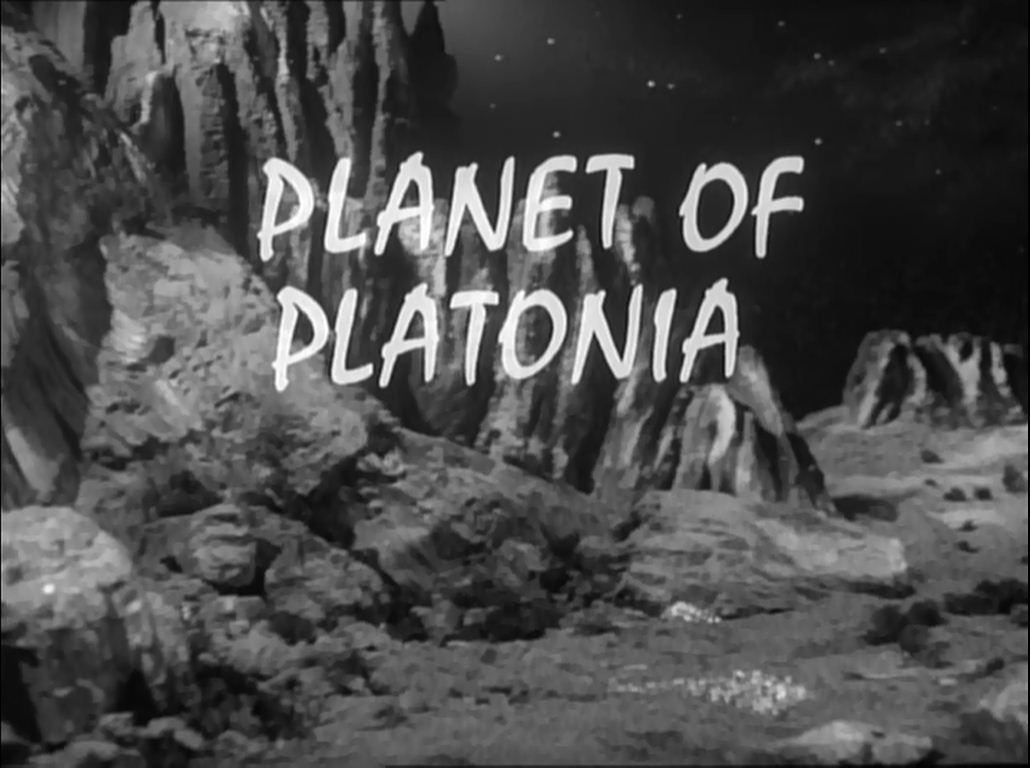

The Platonians are ruled over by King Bazan, who's had a lovely portrait done of himself by the same person who painted the Zanadu portraits in the previous episode:

Bazan intends to travel to Earth and trade some of his heaps of platinum for minerals the Platonians are desperately short of. Unfortunately, he has an implacable enemy, Ginarva (who we sadly never get to see) who thinks the best way to deal with the people of Earth would be to invade them, and who's engineered a series of assassination attempts. Clearly they're pretty rubbish assassination attempts, and given that the only other Platonian we meet in the episode is Bazan's servant, called (believe it or not) Volvo, it's not a massive shock when we find out who Ginarva's agent in the palace is.
The Fireball XL5 crew travel to Platonia to escort Bazan safely back to Earth, but while Steve and Venus are enjoying a seven course meal with the king, his nefarious servant deactivates Robert, the ship's long-suffering robot pilot, and then implants a bomb in his chest.


Steve Zodiac exposes Volvo as a baddie, and finds out there's a bomb aboard the ship somewhere, but sadly, despite the fact that he's transparent, nobody pays enough attention to poor Robert to notice the whacking great box in his chest area. Volvo gets thrown in Fireball's onboard Space Jail (yes, Space Jail).

The rotter escapes into space though, where for some unknown reason he's able to breathe perfectly well, he just floats about a bit. The Fireballers work out that he's going to be picked up by Ginarva's ship though: in Venus's memorable words, "Of course! Anyone ejecting into space without organising a pickup would be a tootie". They somewhat callously blow up the ship and everyone on it, and Steve ventures out to bring back Volvo - but will he reveal where the bomb is in time?


One thing that gets increasingly disconcerting throughout this episode is the amount of close-ups of real human hands wearing gloves to make them look like puppet hands. It's all a bit creepy.

Like all the episodes of Fireball XL5 I've seen so far, I think Planet of Platonia is adorable in its silliness. You can watch it here and see what you think:
And finally, what's at the top of the charts this week? Well, it's still Cliff Richard and the Shadows. Here are both the A-sides of their single:
Saturday, 19 January 2013
Saturday 19 January 1963
It's Saturday, which by TV listings magazine logic means it's the start of the week. Britain's still in the grip of the coldest winter in living memory, and stunned by the unexpected death the previous day of Labour leader Hugh Gaitskell. But let's turn our minds away from such matters, and our eyes toward the wonders provided for us by ITV.


There's also been a change of cast (with no explanation offered for it): Sir Andrew Wilson's gone, replaced as Craig's boss by Chief Superintendent Stock (Anthony Marlowe), who's just as grumpy but has far weedier eyebrows - though he tries to compensate for this by affecting a bow tie and a tweed hat. There's no travelling to far-flung places and escorting beautiful princesses for Craig this week: he spends The Big Time chasing round London in search of a tramp. True, he's a tramp who's snatched a bag containing thousands of pounds worth of uncut diamonds, but it still seems rather a comedown. What's more, Craig's even got a new hairdo, his once proud quiff now sloppily plastered over his forehead.
Also after said tramp, Dan Rooney (Ghost Squad takes place in a world of stereotypes where all tramps are Irish and, consequently, dim) are the diamond smuggling gang led by the rather sexy Mr Welcome (Derek Waring), who happily takes over from Craig in the impressive quiff stakes.

With all these confusing changes, it's good to see that Craig's attempts at going undercover are still as lame as ever. This week he's pretending to be another Irish tramp, Joe O'Farrell, with an accent as unconvincing as his five o'clock shadow.

The director of The Big Time is Peter Sasdy, who'd go on to make films for Hammer as well as a lot of classic TV. He helps make the show nice to look at despite a rather ho-hum plot, with interesting shots like this:

There's even an unexpectedly gruesome moment when the gang finally catch up with Rooney:

But the difference in production values from the earlier Ghost Squad episodes is emphasised most strongly when a microphone descends briefly into shot in one scene, something almost unthinkable in an ITC film series (that's always-popping-up-in-shows-like-this actor Geoffrey Chater on the right, as suave, cigarette holder-clutching Mr Jason, the real brains behind the gang):

If, like me, you're fascinated by 1960s Britain, the highlight of the episode is a lengthy montage sequence that sees Craig purposefully striding about London in front of some great background details.


More tramps on the menu in tonight's next offering:

Tonight's sketches underline the extent to which Arthur and Johnny Speight's humour is of a class-based kind that doesn't really exist any more, at least not in mainstream TV shows (and Arthur's hugely popular show couldn't have been more mainstream). Exasperating and belligerent they might be, but Arthur's characters are mainly real working class heroes, standing up for the common man against supercilious toffs who take it as read that they know best (invariably embodied by Nicholas Parsons). Nowhere is this better displayed than in this edition's main two sketches (the show's format: two short sketches, two long sketches and a musical interlude now seems pretty strange). In the first, Arthur wanders off the street into the offices of eminent architect Sir Nickle-Arse Parsons, and proceeds to tell him exactly where he's going wrong with his new tower block schemes. Arthur is, of course, well qualified to comment on architecture: "I'm very interested in buildings. It's because I've always lived in buildings."
 |
| "It'll be bigger than that, won't it?" |
Later on Arthur, in tramp guise alongside Dermot Kelly, squats in the grounds of a ducal residence ("these aristocrats, they live like lords this days") and comprehensively winds up estate controller Parsons by refusing to recognise police authority or the very concept of private property. The sketch ends like a socialist Beano strip, with the monocle-wearing duke arriving, revealing he's been reading Tolstoy and cordially inviting the tramps in for a slap-up breakfast and a discussion of how best to implement the Russian author's ideals - as Parsons fumes outside.

Singing for us tonight is Susan Maughan, of "Bobby's Girl" fame. She performs her new single, "Hand a Handkerchief to Helen" (a gloating reference to her brief chart ascendancy over rival Helen Shapiro) and then gives us a blast of "I'm Just Wild About Harry", perhaps for the benefit of older viewers intimidated by all the yeah-yeah-yeah-ing in the hit parade.

Ghost Squad's not the only show tonight with a change of personnel:


No Cathy Gale tonight: instead Steed's accompanied by her occasional replacement, nightclub singer Venus Smith (future Playschool presenter Julie Stevens). This is Venus's third appearance in the show, and she's had a bit of a makeover since last she turned up. Previously a bewigged, Peggy Lee-type chanteuse, she now seems a lot younger thanks partly to a becomingly elfin blonde crop and Mary Quant-type fashions, and partly due to being written with a far more girlish personality, a mild Northern accent and a Penfold-like tendency toward exclamations like "bloomin' eck!" that all seems like a deliberate attempt to distinguish her from Mrs Gale.

Box of Tricks is an odd little tale that unites the seemingly disparate worlds of cabaret, national security and alternative medicine. We're taken on a brief tour of real Soho nightspots, ending up at the not-real Gemini, where Venus is currently singing every night in her inimitably jolly style (an engagement arranged, unbeknownst to her, by her friend John Steed).


The assistants of the club's extremely camp magician have a worrying tendency to die on stage - and what are the strange voices Venus has been hearing backstage, seemingly including that of national security advisor General Sutherland (Maurice Hedley)? Steed sweet-talks Venus into doing some investigating for him, helped by the fact that she's an old friend of the general's daughter Kathleen (Jane Barratt), a great fan of the dodgy Dr Gallam (Edgar Wreford), and his little boxes of minerals which can supposedly cure any ill. To try and solve the mystery of leaking secrets Steed goes undercover in not one but two different guises, and Patrick Macnee has great fun hamming it up in the roles of the general's chatty masseur and a millionaire hypochondriac seeking the doctor's help.
 |
| More startling Avengers nudity |

For me, the thing that makes Box of Tricks stand out is that, apart from Maurice Hedley (the prime minister in A for Andromeda) I don't think I've ever seen any of the episode's guest cast in anything else. Which considering the amount of time I've spent goggling at old British films and TV seems quite incredible really. Out of the episode's performers though, the undoubted star is this elderly gent, briefly seen twisting the night away like his life depends on it at the Gemini. It really is quite a sight.
 |
| That's not Susan Hampshire, sadly (I mean the girl, although the man's not Susan Hampshire either) |
Subscribe to:
Posts (Atom)